
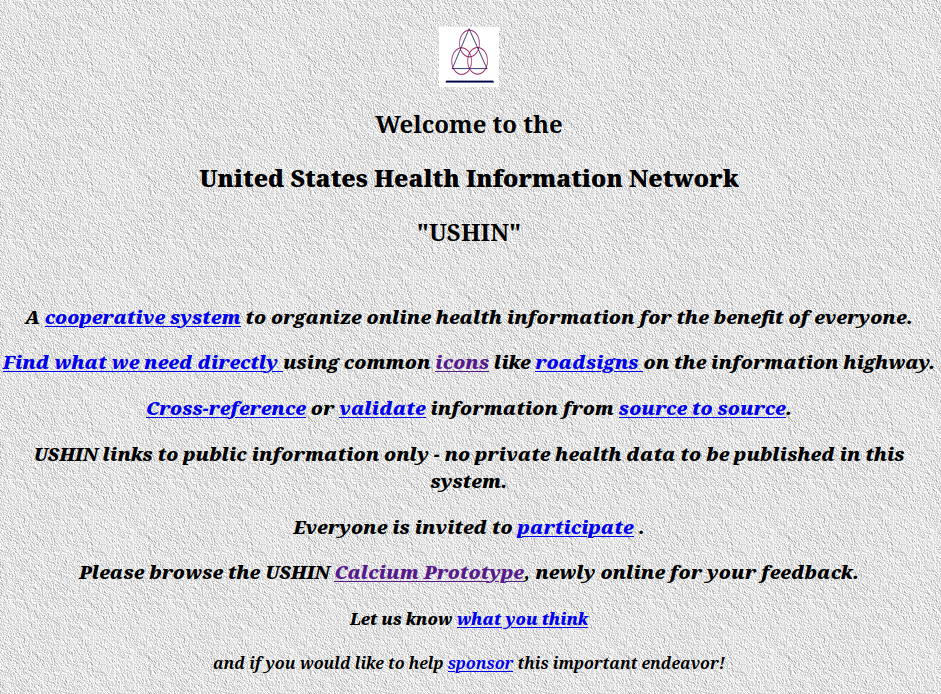
1994
HISTORY of USHIN, Inc. and ushin concept
As a physician in general practice in Tucson, Arizona, Paula Maas, D.O. became more and more concerned that, as pharmaceutical and insurance companies were gaining control of healthcare delivery systems in the United States, many of the most powerful and safest healing options were being removed from reach, erased from view. She envisioned a technology that would evolve into a Rosetta Stone of options for healthcare with connections to a world of expert knowledge that could be easily and clearly collated and compared. Dr. Maas’ vision eventually led to The United States Health Information Network (USHIN), Inc., which was formed as a nonprofit organization. The USHIN system’s purpose was to ensure improvement of health and health care while decreasing costs by means of a uniquely interactive, cross-referenced system of healthcare information for the general public.
The USHIN concept has been online at www.ushin.org, www.ushin.com and/or www.ushin.net since 1993. Use cases and potential features developed and advanced as a product of hundreds of interviews, discussions, forums, conferences that encompassed a full spectrum of interests over more than 20 years. In this span of time, society has come to recognize how desperately such a platform is needed, and the Internet has become mature enough to be ready for the rapid deployment of such a platform.
Beginning in the Spring of 1993, research into determining USHIN’s legal, technical, and political feasibility as well as its potential economic and health advantages commenced. Consumers and health care leaders were polled to assess concept interest and determine implementation steps. The research included interviews that were conducted with experts in the fields of health administration, law, medicine, telecommunications, statistics, linguistics and economics. Much time was spent with governmental policy leaders from the National Library of Medicine and experts from the Health and Human Services and Centers for Disease Control and Prevention.
United States Health Information Network, Inc. incorporated as a 501(c)(3) in 1994. USHIN had participation from a variety of healthcare stakeholders, community advocacy organizations and individuals as members of the board and as advisors. Two local influential nonprofit institutions, Information and Referral and the Food Bank, participated. Representatives joined in from the University of Arizona’s Business Department and Information Technology Department . The Pima County Medical Society has been an active supporter of the USHIN concept since its inception.
After its incorporation, United States Health Information Network approached and conducted a series of interviews with influential national health care leaders and organizations. These included the American Medical Association, the American Association of Retired Persons, the Pharmaceutical Manufacturer’s Association, Public Citizen, and the Health Insurance Association of America.
Early ushin proposals touted an intelligent evolution of the internet that addressed acquisition, management, and coordination of health information, beneficial for the economy as a whole, and in particular for healthcare and consumer interests. National government and healthcare leaders expressed enthusiasm for an Arizona prototype to test the concept.
In early 1994, popularity and support for a comparative information system for health topics was measured in Tucson and Arizona in a series of public forums. The USHIN concept was presented and discussed in schools, professional and consumer advocacy groups. Hundreds of USHIN concept and history packets were distributed. Small community brainstorm sessions, largely conceptual, produced mockups and tables comparing features. Social service providers, experts in the fields of computers, telecommunications and the “information highway” (the term for digital communications and the internet, at the time) were invited to share their views. The May 1994 edition of Sombrero, the journal of the Pima County Medical Society, contained an article supportive of USHIN which inspired further interest among medical, academic and community service groups and professionals in the community. A health providers’ forum of physicians, researchers, pharmacists, nurses and other health professionals was aired over community cable television. The disenfranchised and a variety of advocates for this population were often part of these panels.
A statewide Arizona conference, “USHIN is Ours to Build”, was held in October of 1994, with almost 600 invitees from across the spectrum of public and business perspectives. Social, political, financial and technical issues were discussed in breakout sessions. All participants were kept updated on USHIN activities.
In the mid 1990’s, two model prototypes were built to test the comparative software concept with rudimentary databases. One of these was conducted by Dr. Sudha Ram, McClelland Professor, Management Information Systems in the Eller College of Management at the University of Arizona. The project resulted in students developing the first USHIN database. They integrated consumer and provider information into a “client-side tools database” that posed a scenario that included sample diagnosis and treatment specifics and presented examples of use.
Later in the 1990’s, while teaching medicine at the Touro University College of Osteopathic Medicine, Dr. Maas introduced the concept of sharing points to compare question results among students preparing for a test. Using the topic of anemia, each created questions and cited answers, relating subtypes of anemia into an interactive matrix. This matrix used USHIN tools for rapid collective learning functionality to model potential professional reference and discussion.
In 2001 a driver who ran a red light brought about a sudden change to Dr. Maas’ perspective – from that of a healthcare provider and educator to that of a recovering patient carrying a controversial and variably managed diagnosis. The injured doctor found that the therapies of greatest benefit to her recovery were outside of the medical paradigm and thus not covered by her health insurance. This experience informed and confirmed the need for easy-to-use, coordinated, public health information.
During Dr. Maas’ journey to recovery, the need for USHIN had evolved and grown into an urgent call for a reference and communication system applicable to serious issues of global concern. In the words of Tim Berners-Lee, on the current state of the word wide web, which he originated, “The web has evolved into an engine of inequity and division; swayed by powerful forces who use it for their own agendas,” he added. “Today, I believe we’ve reached a critical tipping point, and that powerful change for the better is possible — and necessary.” The Solid protocol, for handling personal data, is similar to the original ushin concept of creating everyone’s own medical home.
The early USHIN group’s vision of a medical home would allow one to control one’s own personal health data, share it with whomever one chooses, and strip it of identifiers to co-create a living medical, health and wellness source of information for everyone – providers and those in need of care. It would allow the evolution of healthcare on the basis of merit, nurtured by science, shared inclusive analysis, and individual experience.
Instead a juggernaut of centralization rolled though our health care system, academia, the media apparently invincible as online healthcare information removes analysis and choice from human hands. Alternative systems are scattered with no way for people – patients or their caregivers, families, loved ones – to compare options, vet information and sources of information. There is no way to collectively synthesize and deliberate issues, connect with authors and critics for greater understanding, fact finding, fault finding and correction for mutual benefit. Frequently, limited and unsupported information is repeated on the internet, while vetted, affordable options and resources are hidden behind an overwhelming abundance of specialty terminology, commercialism and distractions. This obfuscation of direct access to accountable, comparable, interactive and specific information, products and services made the promise of USHIN ever more compelling.
In 2007 the Board decided to changing the way we were using the term, “USHIN”. Other major groups were using the acronym “HIN” to stand for “Health Information Network” – and these were systems for private medical documents, not the public health information that USHIN would include. To avoid confusion the Board shortened the name of our concept to ” universal shared information” which we designate in lower case letters. The online project name is noted in capital letters, USHIN, which here stands for “Universal Shared Information Network,” still envisions an actual network, not just a concept. This change also envelops the globalized internet as well as the larger scope of USHIN’s endeavor beyond healthcare concerns within our own country. Though we did not change the name of our little company, “United States Health Information, Inc.” we removed the emphasis on health care to avoid confusion with the US government and the debate about the Affordable Care Act that dominated the landscape of healthcare delivery.
By 2011 the need for something like ushin had widened. The Board agreed to include the wellbeing of all creatures, and the planet itself, in the embrace of the health as we conceive it. The scope of the USHIN project is fully inclusive. The tools for arrival at comprehensive, compassionate understanding, appeared central to a healthy world for healthy people. USHIN, Inc. affirmed its existing commitment to improving health and healthcare delivery by developing a range of products and services to enhance the health of people, relationships and communities across the globe.
In 2013 Dr. Maas independently hired April Gendill, Owner at ForneXtSoft in Tucson, to outline the design and formalize the requirements of an USHIN iphone app. A running model, using a few basic USHIN features, created a demonstration of the USHIN’S unique screen functionality. However, in order for the team to focus on creating a prototype of the public information sharing system, the app project was set on a back burner.
The growing information overload, lacking means of cross-referencing or a common indexing system, revealed the internet failure as a place to deliberate society’s pressing problems. The 2013 Snowden revelations brought into stark relief the mandate for a system like USHIN, which could inclusively and with egalitarian and transparent input, handle core issues of security and privacy.
During 2014, Dr. Maas worked with another physician, Lindsey Retterath, M.D. to design the basis for an application of ushin for those with mental disabilities due to various diagnoses and situations. This application, called 1ata, would reduce screen clutter to a single message, yet allow access to other information as needed, as well as tie into other accessibility aids and the Internet of things.
By 2015 a diverse core group, known as the “Community of USHIN Supporters” was working together to research the ongoing need for universal shared information, and created a well-documented statement of need which was co-edited and presented for review by technical, internet, social and linguistic experts for feedback.
Dr. Maas handed ushin literature to Noam Chomsky’s wife, Valeria, who invited a small group of ushin enthusiasts to meet with the couple in Cambridge, Massachusettes. The professor recommended that we contact a handful of prominent individuals in economics, social activism and media and suggested that inter-disciplinary conversations might be facilitated with the ushin discussion, around academic topics. In an mature, distributed ushin system, the discussion would branch off into subtopics, the public could also join in. If adopted widely, ushin could help provide the tools to lay the foundation for a well-constructed common sense.
The Supporters held a brief series of USHIN Discussions in which groups tested the meaning shapes around a variety of central issues. Enthusiastic kudos and effective results confirmed that the project remained on course to meet real needs of diverse peoples. Among the topics discussed was the 2016 Arizona primary election, during which citizens were upset about losing their opportunity to vote for their chosen electoral candidates. Discussion participants expressed the need for inclusion, and shared their anger and despair. The USHIN Discussion also revealed specific facts, those which were addressed publicly, and those which were not yet available to the public. The Discussion deliberated strategies that the participants could use in reaching out to specific people, agencies and other entities, both for the missing facts, but also to inform the public about the decision-making process that led to the frustration of democracy in this instance. The group concluded that if USHIN had already been in place, those citizens caught in a confused moment may have had the opportunity to learn of the problems and work out strategies together.
While the Internet has fostered the development of walled communities, people hanker for meaningful communication that bridges our societal divides. Strings of online commentary do not satisfy people’s yearning for depth and understanding from a spectrum of opinions. Current internet platforms and services publish vitriolic comments from trolls who seem to be undermining any service that commentary might offer. USHIN can connect threads among a variety of communication channels, reference systems and the blogosphere, and can allow an easy weave of meaningful conversation and communication. The social web is ripe for tools that connect existing platforms. USHIN moves to solve what is lacking with current technology, while it remains a concept open for deliberation, ready to be improved upon or replaced in favor of a better way.
After two years of research into evolving needs “on the ground,” and how technologies are and are not addressing even the most compelling needs and injustices, and into what might gently transform our frightening trajectory, we collaboratively finished the summary booklet of the U4U Prototype in February 2017. We extend to you an invitation to participate in the evolution of the Prototype, leading to its launch this coming summer. For the”pre-prototype” we are slowly gathering a range of points that Supporters and invitees would like use for deliberation in the actual ushin Prototype. This would lead to the co-creation of an emergent shared map, built using existing open source software in a process of volunteer “ushering.”
In these first few months of 2017, a turbulent time after the 2016 presidential election, citizens who were never active before have begun seeking ways to engage meaningfully and to bridge the growing divide in our society. A group that included community activists in the Tucson area quickly coalesced, seeking to create a community calendar that would integrate groups, organizations, actions and issues so that anyone could easily plug in where most needs were met for self and others. USHIN pointed out the technical difficulties in creating a “mega one-stop-shop calendar site that everyone comes to” that seemed an obvious solution to bring people together. As the ushin.net site launches, the Supporters are collaborating inclusively with existing calendar and activist groups of Tucson to support and connect and enhance what each is doing and solve a few of the latest communication challenges. This project is a real-life test of some of the ushin features that is also designing a potentially highly valuable integrated community calendar.
There is an overlap between ushin supporters and the Tucson compassion and nonviolent peace and justice movements. Dr. Maas honors the work of Teresa Cowan Jones, who coordinates the Compassion Coalition in Tucson, served on the USHIN, Inc Board of Directors and hosted a weekly Sacred Space. The two co-athored a chapter on Mercy for the Community Toolbox to describe ushin and other tools of compassionate action beyond the constraints of our outmoded dog-eat-dog paradigm.
The community of USHIN Supporters have deliberated what might be our best, most impactful strategy at the present time. In this process, much attention and funds were spent on consideration of USHIN, Inc. intellectual property and the costs and benefits of protecting it. After input from attorneys and team advisors, the Board moved to table any decision about protecting our interests in the USHIN system. While there would have been monetary advantages to pursuing this, there were more compelling social and moral incentives to give the intellectual property away in step with the “free and open” code of the open source movement. Giving away ushin, which will help foster its use as widely as possible, is our company’s current strategy. Designs for ushin’s potential manifestations and a road map for how to implement them collectively would also be supplied to each interested entity. With the understanding that it is unlikely that all people will congregate around a new ethic, a small percentage of us will work to meet needs, using nonviolent methods and effective tools that reap the fruits of understanding and compassion. We USHIN Supporters will make our impact, sprout new ushin experiments, and evolve into something we may not now imagine.
The group’s focus for next several years was on design of a 8-shape of model for compassionate communication and deliberation. The group constructed paper models, physical charms, group protocols and refined the meanings of the shapes in groups and community events in homes and collaborated closely with other Tucson community groups.
Later a small tech team under the direction of Joseph Turner experimented with ushin shape annotation in emacs with file sharing over cutting-edge peer to peer network protocols and nuanced user settings for topic gathering and peer curation. Find brief description in the Projects tab here or visit dev.ushin.net for information and presentations about the software.
There are now dozens of alternatives for federated and decentralized messaging, file sharing, peer to peer content storage, feeds, an of course independent publishing on shared platforms and individual sites, blogs and podcasts. Now we can create websites in our cell phone browsers, and there are AI options to deliberate for us. Though we are interlinked and advances – but none yet collaboratively deliberate.
The goal persists among our tiny, growing, community to forward personal responsibility and agency to care for our minds, bodies and public commons, with the means for people to come together to deliberate the issues of our time and the merit of actions based on meeting human needs.
As for Dr. Maas, she is still active with the design team and writing a docu-musical to describe the emergence of ushin in song and experimentation with online creative collaboration.